If you’re a dentist, you may be required to maintain an automated external defibrillator (AED) for emergency use. There are a lot of portable defibrillators on the market, but not all of them are ideal for dental offices. Certain features are essential, and certain models outshine others. In this article, we’ll discuss:
- The laws regarding AEDs for dentists
- Why every dentist needs an AED
- The features that are most important for dentists
- The best AEDs for dentists
If you have any additional questions, please feel free to contact AED Leader at any time. Our friendly and knowledgeable team will be happy to work with you and help you find what you’re looking for.
Are AEDs Legally Required for Dentists?
A few states require AEDs for dentists who use sedation. They include:
- Florida
- Georgia
- Illinois
- Tennessee
- Washington
In addition, at least two states require all dental practices to maintain an AED (regardless of whether or not sedation is used): Texas and New York. These states also require dentists to maintain CPR certification. For more information, refer to our guides on Texas AED laws and AED requirements in New York.
Why Every Dentist Needs an AED
Regardless of the law, every dentist should have a portable defibrillator at the ready—especially dentists who use sedation. Though it’s rare, sedation is sometimes linked to sudden cardiac arrest (SCA), and dentists should always be prepared for this possible eventuality.
Research Reveals a Link Between Anesthesia and Cardiac Arrest
One study[mfn]jamanetwork.com[/mfn] examined the correlation between anesthesia and SCA over a 15-year span. The researchers documented 27 cardiac arrests among 163,240 sedated patients, or an incidence of 1.7 per 10,000 sedations. Fourteen of the 27 sufferers died as a result of their cardiac arrest (0.9 per 10,000 patients).
This number may seem low. In fact, it’s about .0001% of all cases. But when you consider that a well-run dental practice can have around 1,500 active patients[mfn]dentaleconomics.com[/mfn] at one time, the potential for at least one cardiac arrest is quite significant over the course of a dentist’s career.
When and if that happens, the dentist needs to act immediately. For every minute that the patient’s heart is stopped, their chance of survival declines by about 10%. It’s not always enough to call 911 and perform CPR.
Children May Be Especially Vulnerable to the Effects of Sedation
SCA typically affects older adults, but in cases of sedation, pediatric patients may actually be more vulnerable. The aforementioned study concluded that—compared to adults—children had a threefold higher risk of experiencing cardiac arrest as a result of sedation.
This is important to keep in mind as it becomes a key factor in choosing the best AED for a dental practice. Dentists who practice extensively on children may need to be especially mindful of choosing a child-friendly defibrillator.
Sedation May Contribute to Multiple Causes of Cardiac Arrest
Researchers observed multiple possible triggers contributing to SCA in sedated patients. These triggers include (in order of frequency):
- Failure to provide adequate ventilation
- Overdose of an inhalation agent
- Hemodynamic instability in severely ill patients
A majority of cases involved errors on the part of the individual administering the anesthetic, and almost all cases involved patients with progressive bradycardia.
What to Look for in a Dental Office AED
Certain features are essential in any AED: ease of use, durability, and FDA compliance, for example. But for dentists in particular, the following features are also critical:
- Child-friendliness. As previously noted, children and adolescents are more likely than older patients to suffer cardiac arrest during sedation. A child-friendly AED is one that can quickly be modified for pediatric patients with reduced shock and amended voice coaching.
- Emergency services support. If a patient in your care experiences cardiac arrest, you need a defibrillator that makes the event data (including EKG readings) easy to access. This is for both medical and legal reasons. Emergency responders and doctors will be able to tailor their post-event treatment based on the patient’s condition, and you’ll be able to demonstrate that you did your due diligence in your patient’s hour of need.
- Customizable CPR coaching. Some states require dentists to maintain CPR certification. If you’re already comfortable with performing chest compressions and rescue breathing, you might not want your AED slowing down your treatment with information you already know. Some devices will allow you to customize the voice coaching based on your level of expertise.
- Bilingual capabilities. If your practice employs dentists, dental assistants, and other professionals who speak different native languages, you might want to consider an automated external defibrillator that allows you to toggle between two languages.
The good news is that there are a number of devices on the market that offer all of these features and more.
The Best AED for Dentists
Any FDA-approved defibrillator can potentially save a life in an emergency, but there are a few models that may be particularly advantageous for dentists. These include:
- HeartSine Samaritan PAD 350P
- The Philips HeartStart FRx (recertified)
- The Cardiac Science Powerheart G5
Let’s look at what sets these industry leaders apart.
HeartSine Samaritan PAD 350P
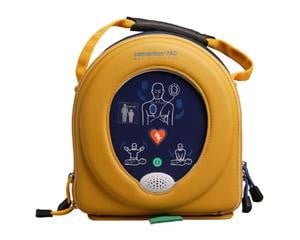 The HeartSine 350P is one of the smallest, most user-friendly, and most cost-effective AEDs available.
- Child-friendliness: The 350P is child-friendly. Just remove the standard pads-and-battery cartridge and swap it out with the Pad-Pak Pediatric Cartridge (sold separately).
- EMS support: The 350P has 90 minutes of internal memory for storing ECG (full disclosure) and event/incident recording. The device connects via Wi-Fi to LIFELINKcentral AED Program Manager, allowing for seamless AED data download and post-event clinical review.
- CPR coaching: The device offers audible CPR coaching with a built-in metronome to help you maintain the optimal rate of chest compressions. It also provides visual cues so that you always know when it’s safe to perform CPR and when to stand clear.
Other features:
- At just 2.4 pounds, it’s one of the lightest AEDs on the market.
- The pads and battery are contained within a single cartridge; you only have to track one expiration date.
- SCOPE biphasic technology optimizes treatment based on the patient’s heart rhythm, promoting more successful outcomes.
- With its IP56 Dust & Water Rating and Military Standard Drop Test certification, it’s one of the most rugged AEDs available.
Cost: $1,350
Philips HeartStart FRx (Recertified)
 Philips is an undisputed world leader in AED technologies, and a recertified Philips HeartStart FRx affords you one of the best deals you’ll ever find on a premium AED.
- Child-friendliness: The FRx is one of the most child-friendly defibrillators on the market. Just insert the Infant/Child key to immediately transform the device from an adult AED to a pediatric AED. The key is good for the life of the AED, and no special pediatric pads are required. This is just one reason why the FRx has a record-low cost of ownership.
- EMS support: The FRx automatically stores event data in an internal memory bank. Saved data includes the status of the AED, ECG recordings, the event rhythm analysis decisions, the elapsed time since the event, and other essential information. The data can easily be transferred to a computer and submitted to emergency services personnel for post-event analysis.
- CPR coaching: CPR coaching is fully customizable thanks to Philips’ Life Guidance assistance. You can press the blue i-button for CPR coaching if desired, or you can perform CPR on your own and use the voice coaching exclusively for defibrillation.
Other features:
- Simple two-button operation is coupled with easy-to-follow on-screen diagrams and voice coaching.
- The rugged, lightweight design can withstand drops of up to 4 feet as well as extreme temperatures.
- A Quick Shock feature allows shock delivery within 8 seconds after CPR.
- Philips biphasic waveform shock delivery helps to promote improved patient outcomes.
- Every recertified FRx is subject to our exhaustive 9-point recertification process and comes with a 3-year warranty, so you can buy with absolute confidence.
Cost: $695 (recertified)
Cardiac Science Powerheart G5
 With its intuitive RescueCoach® technology and IntelliSense CPR guidance, the Cardiac Science Powerheart G5 is a marvel of engineering designed for the lay responder and emergency professional alike.
- Child-friendliness: Connect the pediatric defibrillation pads (sold separately) to instantly reduce the shock and modify the CPR coaching for pediatric patients.
- EMS support: All ECG and event data is saved internally and can be transferred quickly to emergency services via USB.
- CPR coaching: The IntelliSense CPR guidance is fully customizable. Choose the prompts, protocols, and feedback, and receive coaching based on your level of experience. The device can deliver a post-CPR shock in as little as 10 seconds, minimizing delays during the rescue.
- Bilingual capabilities: Switch between English and a second pre-set language at the touch of a button. Voice instructions are immediately adjusted accordingly with no delay in the rescue procedures.
Other features:
- Available in both semi-automatic (user-delivered shock) and fully automatic (automated shock delivery) versions.
- IP55-rated for rugged resistance against dust and water.
- Variable escalating energy supports optimized shock delivery based on the patient’s needs.
- Rescue Ready® indicator makes it easy to monitor device readiness at a glance.
Cost: $1,795
How to Choose the Best AED for Your Dental Practice
Choosing the best AED for dentists is all about knowing your needs. When comparing your options, keep in mind:
- Your budget
- Your level of life support training
- Your staff’s level of life support training
- Your staff’s language preferences
- Whether or not you cater significantly to pediatric patients
- The features and reputation of the AED
Then compare your options and decide which AED is best for you. It’s just one more way in which you can ensure optimal care and added assurance for every patient who steps through your doors.
Check out our AED Coupons page for promotional offers currently available on our website.
Information Sources